
Coteaux du Quercy: the wine of Quercy Blanc celebrates 15 years as an AOC
Approved on 26 October 2011, the Coteaux du Quercy appellation is 15 years old. Grapes, terroir, a thousand years of history and good places to taste it this autumn.

Between the Lot valley and Tarn-et-Garonne, Quercy Blanc takes its name from the pale limestone of its villages and tracks. Lot Tourisme suggests an 88 km circular driving route starting in Flaugnac. It links hilltop bastides, windmills and chapels on the Compostelle pilgrimage route in a single day. Autumn is a particularly lovely time to visit, with soft light, quiet roads and golden vineyards.
The route starts in Flaugnac, a hilltop village above the Lupte valley. Its white-stone houses and church offer lovely views down over the countryside. A detour along a small road leads to the église Saint-Étienne. It is surrounded by vineyards producing the local AOP Coteaux du Quercy wine.
The next stop, Castelnau-Montratier, stands on a rocky spur. This bastide town is built around a central square, with the remains of an old castle and the église Saint-Martin. The church has unexpected Byzantine touches. At the entrance to the town, three windmills stand against the landscape. They are one of the best-known sights in Quercy Blanc.
For walkers, the “circuit des plateaux et des moulins” starts from place Gambetta. It covers 14.4 km and takes around 4 hours, with 265 m of elevation gain.
Between Castelnau-Montratier and Sainte-Alauzie, the moulin de Boisse stands proudly on its hill. The Amis des moulins de Boisse association cares for this fine reminder of the area's milling heritage. Just before Sainte-Alauzie, the loop follows a few white limestone tracks. These wind between the fields and give the local landscape its distinctive character.
In Sainte-Alauzie, take time to wander along the lavender-lined lanes to the white-stone church.
The second half of the route crosses the GR 65, the pilgrimage trail from Le Puy to Saint-Jacques-de-Compostelle. Lascabanes, a stopping point for pilgrims, is home to a former priory. A little further on, the chapelle Saint-Jean-le-Froid is tucked away in an oak grove. Below it, a spring flows from a small cave at the bottom of a meadow. It was once believed to relieve rheumatism. The chapel is free to visit.
The road then passes through Saint-Pantaléon and by the chapelle de Rouillac. Both are further reminders of the area's pilgrimage heritage.
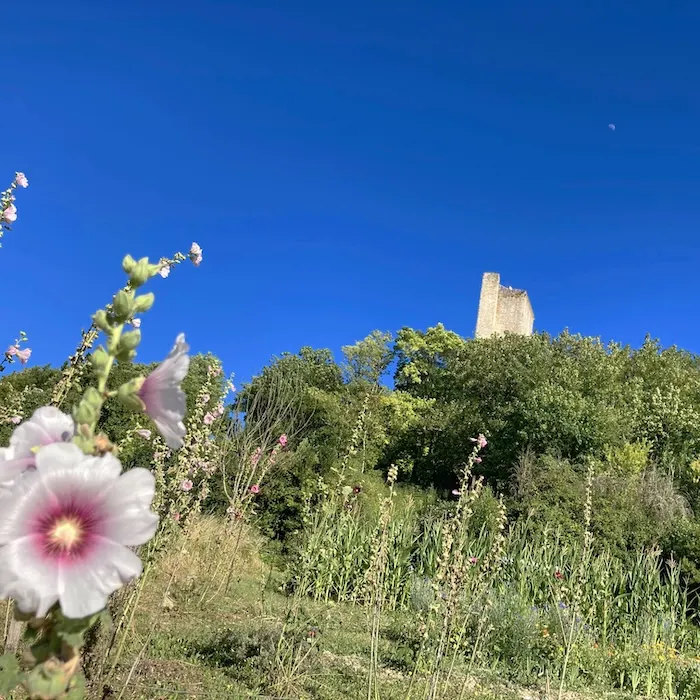
The route ends in Montcuq, overlooked by its medieval tower. Built between the 12th and 14th centuries, the tower is open to visitors. Its terrace offers panoramic views of the surrounding hills. In summer, the lake on the edge of the village welcomes swimmers and families.
Set off on Sunday morning. Start at the Castelnau-Montratier market to fill your basket with local produce. Then enjoy a picnic near the moulin de Boisse before exploring the Compostelle section in the afternoon. Save Montcuq for the end of the day, when the low sun lights up the white stone.
Louroca, in Barguelonne-en-Quercy, is just a few minutes from Montcuq: an ideal base for this circular route.
Follow local news on our Facebook page
Approved on 26 October 2011, the Coteaux du Quercy appellation is 15 years old. Grapes, terroir, a thousand years of history and good places to taste it this autumn.

As the crocuses bloom, Cajarc celebrates Quercy saffron. Enjoy saffron farm tours, trimming demonstrations, a producers' market and a traditional banquet.

Founded in 1977, the Montcuq-en-Quercy-Blanc equestrian endurance race celebrates its 50th edition in late October. The free event covers 200 km in two stages through the Quercy Blanc.