Quercy Blanc by car: an 88 km loop through bastides, windmills and chapels
From Flaugnac to Montcuq, spend a day exploring white-stone villages, windmills and chapels on the Compostelle pilgrimage route. Follow the route step by step.

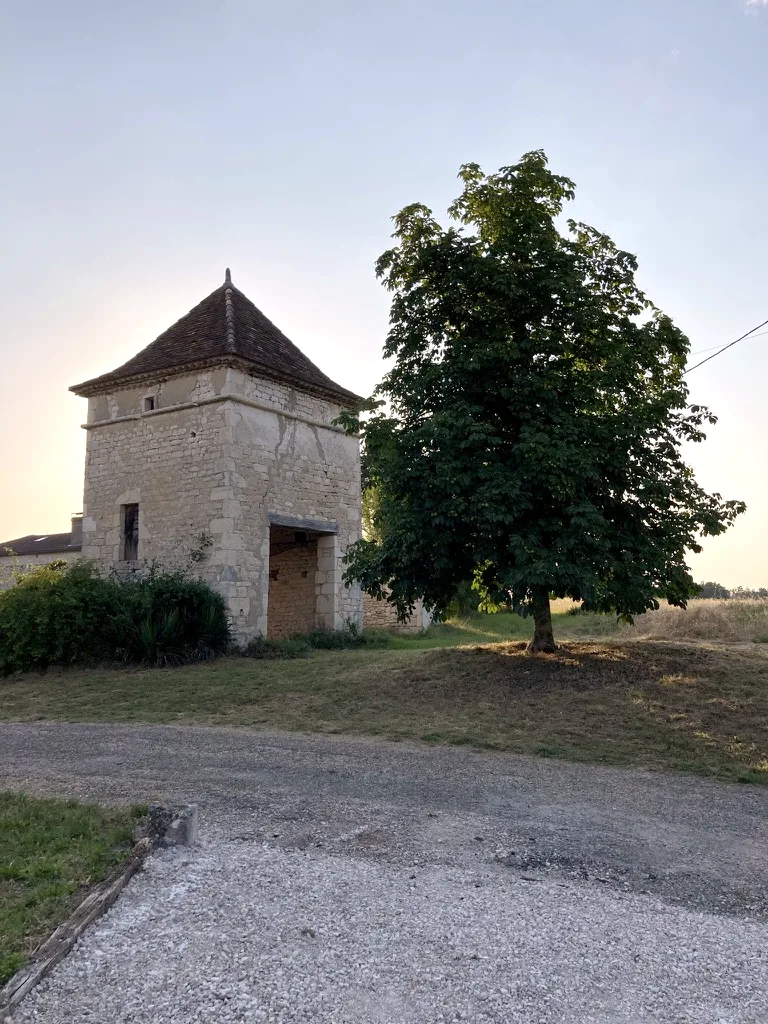
In Quercy, every drive brings its share of dovecotes. Attached to a farmhouse, perched on pillars in a meadow or crowned with a pointed roof, they belong to the landscape as much as vines and dry-stone walls. Yet these little towers tell a much bigger story. It is the story of farming that turned pigeon droppings into white gold for crops.
Before the French Revolution, land in Quercy was divided into many small plots. Farms kept few livestock, so manure was scarce. Pigeon droppings, known as colombine, became a much sought-after fertiliser for vegetable gardens, hemp and vines.
Pigeons also provided meat and eggs. The dovecote was a status symbol too. Its size and the care taken over its construction reflected the family's wealth.
Elsewhere in France, the right to keep a dovecote was often reserved for the lord of the manor. In Quercy, any landowner could build one. The area of land simply had to match the number of pigeons housed. This freedom largely explains the exceptional number of dovecotes in the Lot and neighbouring Tarn-et-Garonne.
As you explore, you will spot several types:
Look out for the details too. Projecting cornices, glazed terracotta tiles and zinc bands all formed barriers against predators. A terracotta finial often tops the roof, sometimes in the shape of a bird.
In our part of the region, the limestone is pale and soft. Dovecotes here are often built from rubble stone with lime render. Some have timber frames filled with brick or earth-and-straw daub. The distinctive brightness of this stone gives the landscapes of Quercy Blanc their name.
There is a fine example at Les Bordes, in Lauzerte. This dovecote stands on columns and is freely accessible all year round, according to the Quercy Sud-Ouest tourist office.
To see more on foot, follow the “Les moulins du Quercy Blanc” (PR2) walking route. This 21 km circular walk starts at the ramparts of Lauzerte. As early as the second stage, it passes a remarkable timber-framed dovecote from the 16th or 17th century. It has a hexagonal base on stone pillars, a brick-and-timber body, a roof lantern and a pigeon-shaped finial. The route continues towards the restored windmill at Pertenaïs and the chapel at Carcès, in the Séoune valley. A 2 km alternative section lets you shorten the walk.
Autumn and winter are perfect for dovecote spotting. With less foliage, their outlines stand out more clearly across the fields. Head out in the late afternoon, when the low sun warms the white stone. Keep an eye on farmhouse roofs too. Their finials can hold some lovely surprises.
Louroca, in Barguelonne-en-Quercy, is surrounded by this dovecote-dotted countryside, close to Lauzerte.
Follow local news on our Facebook page
From Flaugnac to Montcuq, spend a day exploring white-stone villages, windmills and chapels on the Compostelle pilgrimage route. Follow the route step by step.

Approved on 26 October 2011, the Coteaux du Quercy appellation is 15 years old. Grapes, terroir, a thousand years of history and good places to taste it this autumn.

As the crocuses bloom, Cajarc celebrates Quercy saffron. Enjoy saffron farm tours, trimming demonstrations, a producers' market and a traditional banquet.